Showing posts with label outsourcing. Show all posts

Monday, August 17, 2015

6 Reasons Why Business Process Outsourcing is Dead

A decade and a half ago business pundits in the marketing procurement area hailed it as a savior. Business process outsourcing – or contracting the operations and responsibilities of marketing procurement to third-party service providers – promised cost savings that would increase a company’s flexibility. According to these pundits, business process outsourcing provides some advantages that can increase flexibility. It helps transform fixed costs into variable costs. It allows more focus on core competencies. It increases speed in certain processes by removing them from within the organization’s bureaucracy.


Business process outsourcing is not, however, without its downside. As the business environment has changed over the past fifteen years so have many organizations’ views and values of flexibility. This has brought to light issues that work against the advantages of business process outsourcing. Even Wikipedia notes that service issues, unclear contracts, changing requirements and unforeseen charges, coupled with dependance on the business process outsourcer (BPO), actually reduces flexibility.


With that in mind, the only conclusion is BPO is dead and here are six reasons why.


1. It’s Too Expensive


BPOs charge fees for their services and markup what they procure to make a profit. As organizations demand more from their BPOs, those fees and markups increase negating the promise of flexibility-enabling cost savings. As an example, a review of InnerWorkings’ 2014 financials indicate revenue of $1,000,133,000 and gross profit of $229,459,000. This surplus accounts for a 22.9% excess companies paid beyond the actual cost of the printed marketing materials.


Businesses seeking more than the ability to off-load work to someone else can save more without the BPO interfering as a middleman.


2. It Takes Control Away


At first the idea of making supporting operations someone else’s problem sounds inviting. Then something goes wrong that makes an impact on core functions and the control that was given away is sorely missed.


When an organization has control over all of its operations potential issues can be caught before they impact core functions. Just ask any marketing department.


3. It Blocks Transparency


Giving up control also means giving up transparency into details that are critical to planning and budgeting for resources, projects and strategies. Without transparency, efficiency stagnates, reliance on outsiders is compounded and flexibility suffers.


With the help of software built for the operation at hand, organizations ensure transparency, achieve efficiency and become more flexible on their own.


4. It Impacts Quality and Service


While a BPO may not set out to reduce quality, its idea of what constitutes the best quality and level of service probably differs from yours. Giving up control also means giving up your definition of quality and service levels.


Operations responsible for the production of marketing materials critical to an organization’s image are better served when control remains within the organization. Creative cannot communicate clearly its ideas to the marketing manufacturer through a middleman. Its like the children’s game of whisper in my ear and I’ll whisper into someone else’s ear, and guess what was originally said.


5. It Stands Between the Organization and Its Vendors


When an organization uses a middleman like a BPO there is no direct relationship with vendors, resulting in goods and services produced with little interest or knowledge in who will use them or how they will be used.


While vendor relationships require careful monitoring and management, the synergy between organization and vendor is often valuable to the outcome of a project.


6. It Puts the Organization at the Mercy of Another


By using tools built for automated communication, process optimization, establishing accountability, gaining full transparency and instant reporting, an organization can gain flexibility while not being beholden to a third party for results.


Business Process Outsourcing is Dead – Software Tools are Alive


Some think that business process outsourcing is a way to minimize marketing procurement operations in order to focus more resources on core operations. Unfortunately, experience can prove otherwise.


Marketing initiatives can only be optimized when marketing procurement remains in charge, gains full transparency into projects, works with trusted and proven vendors, and has control over the dollars that would better be spent on improved marketing initiatives. By obtaining powerful software tools to support marketing procurement, efficiency improves, costs go down and more market reach can be obtained for the same or less market spend.


Marketing procurement has one goal and that is to produce the best marketing possible within budget. BPOs also have a goal which is to maximize their brokerage fees.


6 Reasons Why Business Process Outsourcing is Dead

Friday, March 20, 2015

How to Make Money in Today"s Printing Business

In case you haven’t noticed, the printing business isn’t what it used to be. But before you begin to think this is another of those ‘print is dying’ articles, let’s clear the air, it’s not. The printing business is far from dead but it certainly has changed. The days of constant incremental growth and an influx of new clients have gone the way of the buggy whip. There is still success to be had in today’s printing business but the model for making money is contrarian to familiar practices. And, believe it or not, the latest breakthrough in production technology plays no role in it.


Peaks and valleys are part of the business cycle in any industry. There are times when customers buy and times when they don’t. Many products can be manufactured in advance, stockpiled and sold on demand. For example, if you were in the toothbrush business, you would know how many toothbrushes you could sell in a year and when the peaks and valleys were. You would equip, supply and staff your factory to manufacture evenly throughout the year. You would stockpile production during valleys so there was enough to sell during peaks. But you are in the printing business and printing is different. Printing is custom. Every print job is unique. You can’t produce printing in advance, stockpile it and sell it on demand because your clients have to have something for you to print before you produce it.


Printers, for hundreds of years, have followed a different model. This model is based on being prepared for anything that could come through the door and then waiting for it to happen. Like the toothbrush manufacturer, you know in general when your peaks and valleys are, but unlike the toothbrush manufacturer, you can’t produce in advance and stockpile. And, at the same time, you wouldn’t want to turn away a client at any time, peak or valley. So the classic model for printing is to staff and equip for the highest of peaks and have a lot of downtime where both machines and hands are idle while overhead adds up waiting for clients to need your services.


Simply stated, in today’s business environment, printing success doesn’t come through increased business or new clients. If you continue to follow a model built around downtime waiting to be filled, the money you earn during the peaks will disappear during the valleys. To make money in today’s printing business you need to do the opposite of what the industry has considered logical for centuries.


Success in today’s printing business comes from efficiency and partnerships. To make money printers need to staff and equip for the valleys, not the peaks. You need to take inventory of actual production and eliminate operations that are not being fully utilized. If you are not readily selling non-core services like prepress or bindery, why bother when you can turn to partners who do them as their core operation? Ultimately, if a printer can trim fringe operations and focus on core services so that 80 to 90 percent of capacity is consistently being used, that printer can make money in today’s business environment.


But what about offering full service or being capable of taking work when the plant is running at capacity? That’s where having a variety of partners close at hand comes into play. Outsourcing among printers is far from new. But to achieve success in today’s environment, it is critical. That is one of the keys behind the success of the major, multi-plant and conglomerate printers like Donnelly, Cenveo and Quad. They operate at valley levels and then shift work among their facilities according to capacity or capability. Printers of any size can do the same thing without mergers and acquisitions.


Like most business strategies relying on partners for out-of-scope and beyond-capacity work is not without its risks. Can the partner live up to your standards of quality? Will the partner provide great on-schedule, on-service at a price that can be marked-up? Can the partner be trusted in terms of confidentiality and non-compete? These concerns are real, complex and difficult to overcome, but, with the right insight, preparation and tools, they can certainly be mastered.


Aside from the obvious legal agreements, printers, wishing to leave the past behind and follow today’s path to success, need software specifically built for the job – software that is powered by a method created for custom-produced goods and services like direct mail, marketing materials, publications, packaging, digital and all things print. They need software that empowers them to establish crystal clear, bullet-proof specs for the work they are outsourcing to partners. They need a way to qualify, manage and score their partners objectively based on capability and output. They need to automate the time-consuming process of sourcing and awarding the work. They need to be able to track outsourced jobs with precision and know that, on each and every job they outsource to a partner, they will receive the best possible combination of quality, timeliness and price. Simply stated, they need to be able to guarantee quality and service while buying the project for less than they can afford to make the project.


There aren’t fifty different alternatives to meet these needs. Spreadsheets won’t do it. General procurement, enterprise resource planning, customer relationship management and production workflow software can’t do it. There is only one solution – eLynxx cloud software and the eLynxx exclusive sourcing method that’s so powerful it’s been awarded five United States Patents to date.


eLynxx Solutions knows the printing business, because it has been part of the business since 1975. Through 40 years of revolution in the printing industry, eLynxx Solutions has provided the experience, expertise, innovation and technology that has allowed printers and print buyers alike the opportunity to mutually profit from an ever-changing marketplace. Having processed over 3.2 million print projects valued at well over $9.1 billion dollars, there is no question that eLynxx Solutions has helped a lot of people. The only question is when can eLynxx Solutions start helping you make money in today’s printing business?


How to Make Money in Today"s Printing Business

Friday, March 13, 2015

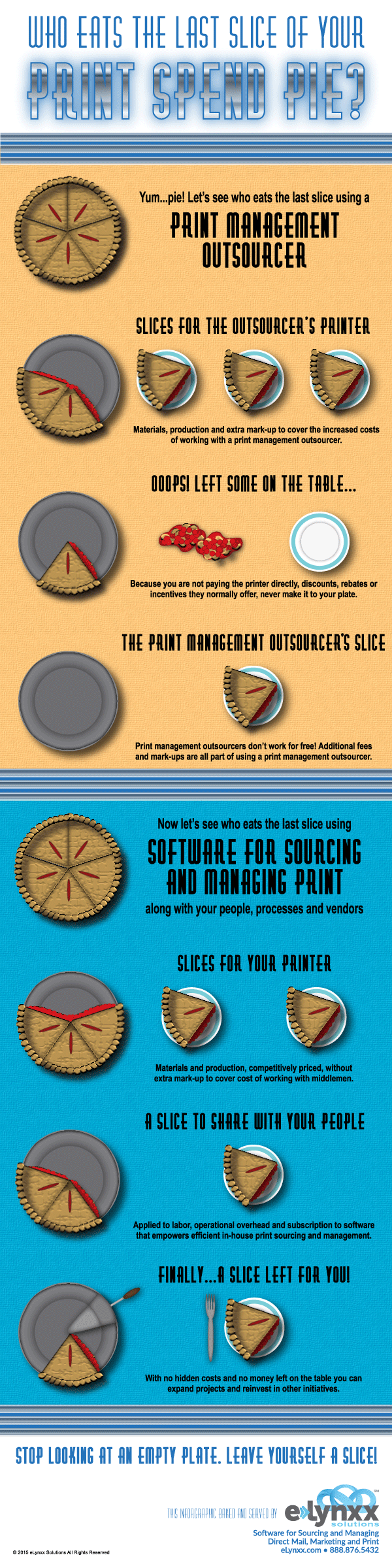
Who Eats the Last Slice of Your Print Spend Pie?

We’ve been hearing the print buying community ask “does outsourcing really save any money and where do the dollars go compared to in-house print buying?”


When you’ve been helping print buyers at many different levels for four decades you gain a lot of insight into a lot of areas. Through analysis of data, first-hand experience and knowledge gained from the trial and tribulations of people we help, this topic is one of those areas.


Because we like calculating the ratio of a circle’s circumference to its diameter as much as the next guy – and we also enjoy fruit-filled baked goods – we thought we’d start celebrating “Pi Day,” a day early with a look at Who Eats the Last Slice of Your Print Spend Pie?


Click the Image to Open – Click Again to Enlarge to Full Size


Click to View Full Size


Who Eats the Last Slice of Your Print Spend Pie?