Wednesday, April 22, 2015

eLynxx Solutions CEO Mike Jackson Featured in Xplor International Interview

Xplor International, a not-for-profit association focused on technology for, and production of, high volume printing for consumer communications, featured an interview with eLynxx Solutions own Mike Jackson in the most recent issue of their E-Document News. In the interview Jackson discusses workflow technology, the impact of the cloud and software as a service, compliance, efficiency and options for custom tailored software.


Read the interview: http://goo.gl/u4X6H2


Visit Xplor International: http://xplor.org


eLynxx Solutions CEO Mike Jackson Featured in Xplor International Interview

Friday, April 17, 2015

The Catalog Comeback

As a kid, back in the 1970s and early 1980s, I would spend almost as many lazy hours engrossed in catalogs – the Christmas toy and wish books especially – as comic books and Mad Magazine. I can even trace my interest in graphic design and marketing communication to a time when I would combine my affinity for catalogs, comic book fantasy and satire to create parody catalogs with ridiculous themes like discount gadgets for aspiring superheroes and evil underworld masterminds. Although I never achieved my goal of hijacking the grade school mimeograph machine to actually produce my early work; my career eventually led to a critical role in the catalogs of a major giftware and collectables wholesaler. To this day, I still enjoy picking up and flipping through a catalog. That’s why I’m excited to see that they seem to be making a comeback of sorts.


According to The Wall Street Journal and the Direct Marketing Association, the peak of catalog distribution didn’t actually occur until 2007 when retailers mailed 19.6 billion in the U.S. By the time 2007 had rolled around, Sears, the granddaddy of all catalog retailers, was long out of the large-scale catalog scene. Other retailers had obviously picked up the slack and then some. Unfortunately, the years following 2007 showed a constant, and often steep, trend of decline. In the very midst of that slump, J.C. Penney, the last remaining big gun of the catalog world, had phased out their so-called Big Book and all of their specialty catalogs.Finally, in 2013 catalog distribution was up, for the first time in six years, to 11.9 billion. Far shy of the 2007 peak but up nonetheless.


Earlier this year Penney’s made several big announcements. One, of course, was that they were planning to close underperforming stores. Another was that they were bringing back the catalog. The two announcements were an interesting juxtaposition since the start of many of the company’s financial woes coincided with the time it decided to dump the printed catalog and make mail order a strictly online operation. Far from the thousand page, soup-to-nuts behemoth of old, the company’s first catalog in five years was to be mailed in March. In the month since it was supposed to be distributed, I have not seen a new J.C. Penney catalog in the wild, although I understand that it was planned to be 120 pages focused on home goods. More akin to their old specialty catalogs than their Big Book.


Penney’s, it seems, is on-board with the realization of many other retailers; printed direct mail catalogs are effective in leading lifestyle-driven consumers to make in-store and online purchases. The key is to also realize that catalog marketing is highly adaptable and, given today’s design, printing and mailing technology, even nimble. When it comes to presenting a massive amount of products and related information as a point of reference, as was the main role of the huge old full-line print catalogs, the web is a worthy successor. In instances where many variations or options exist for products, the web can even be superior. However, when it comes to appealing to the senses, presenting shoppers with ideas, forming opinions and helping them make a buying decision on an emotional level, print can’t be beat.


There is nothing like moving through the thick, glossy full-color pages of a targeted, specialty catalog and turning to a beauty, or hero, page to see the products staged in a way that makes the reader want to replicate that scene in their own life. They see what could be the answer to their needs or desires, they get to understand about each of the products and they may even gain some insight from a designer or an expert in an article, separate from the product detail copy, that relates to the scene that has been set. With a quick look around to superimpose the beauty shot over their own surroundings, the reader is off to the website, catalog and credit card in hand, typing item numbers and filling a cart. In this way, print catalogs are not simply listings of what a retailer has for sale, they are a connection to the audience’s lifestyle.


Sure, you can put beauty shots and inspirational copy on a website. But the audience has to know it is there. Yes, you can let them know the website is there through email, but email is easy to ignore. You can have a web catalog site highly optimized for search, but the audience still has to be searching for what the site is selling to find it. When a person pulls a catalog out of the mailbox and they hold it in their hands, they have connected with it that’s harder to ignore.


In addition, marketers have much more control over graphic communication in print than they have online. No one knows the size, quality or settings of every screen in a given audience. Responsive web design can account for many of the challenges with screen size, but nothing can prevent low-quality hardware or out-of-whack settings from destroying the impact of otherwise stunning photography and design. If you are in full control of correctly managing your specifications, color standards, proofing and production, you can ensure that what the audience sees is what you want it to see in print.


Today’s printed catalogs may not look anything like the ones that inspired me as a kid. They are, however, still doing what those old catalogs were designed to do – sell to contemporary audiences – and do it well. For that reason I still find inspiration, and sense of satisfaction, when I pick up a printed catalog. Let’s keep ‘em coming!


The Catalog Comeback

Friday, April 10, 2015

Printing is Different and Different is Good

This morning I finally got around to reading the print and communication industry articles that have been piling up in my feed for a few days. Of all of the headlines and synopses, this one in particular caught my eye; US Commercial Printing Shipments Have Strong February, +5.2%, by WhatTheyThink.com’s Dr. Joe Webb. As a marketing communications guy who leans more toward the creative and problem solving side of things, economics isn’t normally shiny enough to get my attention. That being said, even though I am not what you would call a number cruncher, I do have a knack for identifying trends based on observations out in the wild. This particular article seemed to be aligned to one of those observations. Plus, Dr. Joe’s analysis is generally straightforward, concise and often entertaining; so I clicked.


I’m not going to restate everything in the article here, you should check it out yourself, but I will summarize one key point. U.S. Department of Commerce, Bureau of Labor Statistics data shows that after a good January, February’s printing shipments were up over $300 million year-to-year. This means different things to different people. For printers who, as Dr. Joe notes, may still be facing reduced profits, it could mean some wiggle room as they adapt to a changing marketplace. For the people and organizations that put commercial printing to use, it supports the observation that print is not dead, it is alive and viable, but it is different.


Creative impact and efficiency – in terms of production and distribution – along with convenience and visibility – in terms of audience consumption – often drive tactical and media choices in marketing communication. What we print today is different from what we printed in the past. Many of the more pedestrian or throwaway items of the past have shifted to digital formats. It’s efficient and convenient. We can crank those out and reach the audience wherever they are at any time by doing it this way. But what is being printed today, and the people who are behind it, is impressive and surprising. We are printing on surfaces that, when I began my career two decades ago, were unheard of. We are combining print with technology that didn’t even exist ten years ago using processes that seem to be right out of mid-20th century science fiction. Organizations that you normally wouldn’t think to use in the same sentence as printing; companies like Google, eBay and Amazon, have successfully combined big data and high levels of personalization with extremely creative printing.


We may not be printing as much as we used to. What we are printing is more complex, more unique and more strategic than ever before. Organizations that are pouring their hearts, souls, dollars and trust into these projects need access to printers that are adopting new efficiencies and investing in new technologies to meet the needs of today’s print buyer. Print projects, and all of the people who play a role in them, need to be given the recognition and support they deserve. The numbers don’t lie. We are seeing a rebound in commercial printing and it’s not because we’ve given up digital communication and reverted back to ink and paper. It’s because we’re using print in wonderful new ways that, now more than ever, demand stronger marketing supply chains with purpose-built tools and methods for achieving the best possible results.


Printing is Different and Different is Good

Wednesday, April 1, 2015

Five Reasons Why Printed Marketing Materials are Still Important

Despite the fact that we seem to live so much of our lives online, we are still physical beings living in a physical world. Regardless of how attached are to social media we still crave physical communication. For that reason alone, printed marketing materials are still important in today’s digitally saturated environment. Let’s take a look at some of the many reasons that even the simplest of printed marketing communications like direct mail are highly effective in an organization’s outreach strategy.


Exposure


Printed marketing communications offer a great magnitude of exposure and create lasting impact. Their physical form has staying power that allows the audience to interact with them anytime. A publication or even a brochure left on a table has reach well beyond the individual to whom it was sent. This kind of pass-along can be very effective as it occurs in a natural and casual manner driven by genuine interest on the part of the individual.


Targeting


Because of its maturity as a strategy and the vast amount of data that is collected on people and organizations in their physical environments, printed marketing communications can be directed to highly targeted audiences. Variable printing, personalization and mail automation technologies enable even massive direct mail campaigns to be customized and targeted with pinpoint accuracy. This allows outreach and engagement with an audience at a highly effective, personal level without the often creepy feeling that highly personal social media outreach can have.


Branding


Printed marketing communications strengthen a brand by bringing a unified image used across other channels into direct physical contact with the audience. Because print is physical and able to be placed into the hands of prospects and customers it allows for outside of the box creativity such as the inclusion of samples and even multimedia. Printed marketing communication’s physical nature lend it a premium characteristic that can be used to convey quality and luxury. This physical nature can be used to appeal to the senses, like touch, smell, and with some creativity, taste that can not be accessed via other channels. For brands that exist strictly online, print is the perfect way to gain local presence without the need for brick and mortar facilities.


Measurability


Everyone knows that, thanks to tracking codes, online marketing communication is easy to measure. Print communication is the granddaddy of measurability. Coupons, redemption vouchers and other forms of tracking have proven the effectiveness of printed marketing for generations. Tracking and measurability of print campaigns can be done with automated technology or it can be as simple and low-tech as counting coupons or the number of enquiries made.The effectiveness of a print marketing campaign can be easily measured using simple techniques.


Flexibility


The best thing about print marketing is that it can easily be used in a combination with online tools. Not only is it perfect for reaching audiences not engaged with social media, it can be used to connect the physical and online worlds. Scanning technologies and augmented reality make a direct connection between print and digital. Even simple codes can be used to drive customers and prospects to a website. Print can actually be one of the most effective ways to convert offline customers to online and drive repeat or increased online engagement. Believe it or not, printed marketing communication is used frequently and very effectively by online giants like Google, eBay and Amazon.


While advances in media and marketing technology get all of the glory, classic approaches like print are still going strong. It gives access to audience segments, creates impact and builds awareness that will bring new life into any marketing strategy.


Five Reasons Why Printed Marketing Materials are Still Important

Healthcare Insurance Sector Averages Savings of Over 32% in the Past Two Quarters Using eLynxx Software

eLynxx Solutions, provider of software for sourcing and managing print has released data showing marketing and communication material savings of over 32% among its clients in the healthcare insurance sector over the past two quarters. This savings continues a trend for this sector.


Staying connected with both customers and service providers is critical to organizations in the healthcare insurance sector. Because of the highly regulated, personal and official nature of information in the healthcare insurance space, print remains a primary channel of communication. At the same time, especially in such a dynamic and competitive industry, there is always pressure to control cost and achieve better results that often leads to decisions that impact critical operations and materials. For 40 years, companies have turned to eLynxx Solutions to maximize efficiency, reduce costs and achieve better results from their marketing and communication materials.


“Healthcare insurance companies rely heavily on printed communication such as direct mail,” said Mike Jackson, chief executive officer of eLynxx Solutions. “These communications are often quite complex, involving not only personalization but requiring a high measure of security because of sensitive personally identifiable information. Such needs can add substantially to the cost of a campaign. Reducing the per-unit cost of printed communication materials and increasing the efficiency with which they are managed makes a positive impact on a healthcare insurer’s bottom line.” That is why leaders in the healthcare insurance sector turn to eLynxx Solutions. Purpose-built for the sourcing and management of direct mail, marketing and print communication materials, eLynxx software provides the highest possible level of efficiency and coordination. Combined with an exclusive patented sourcing method, eLynxx users from across all business sectors regularly achieve per-unit cost savings of up to 40% on all kinds of custom printed materials while increasing efficiency by an average of 53%.


“eLynxx Solutions is pleased to have been able to save its healthcare insurance clients an average of 32.15% in the past two quarters. This level of savings continues a trend of eLynxx Solutions clients in this sector achieving average annual savings of over 31%.” Jackson noted. Naturally, the efficiency and savings achieved through eLynxx is not limited to those in the healthcare insurance industry.


eLynxx Solutions helps organizations in the education, financial, manufacturing, heavy equipment, building products, technology, non-profit association and shipping and logistics sectors as well. eLynxx Solutions takes an approach of helping organizations extend their capabilities to get better results from a traditionally hard-to-control area of operational spending. With other approaches there is always some level of sacrifice. With the eLynxx approach organizations achieve the best possible price, quality and service on custom-printed materials while retaining control through their own people, processes and vendors.


###


eLynxx Solutions has been providing innovative products and services for helping organizations manage projects and connect with vendors of custom-produced graphic communication, direct mail, marketing materials, publications, labeling, packaging and all things print since 1975. Born, raised and still located in Chambersburg, Pennsylvania along the east coast’s graphic communications corridor connecting Washington, DC, Baltimore, Philadelphia, Pittsburgh and New York City, today’s eLynxx Solutions is a leading innovator and provider of cloud software for the marketing supply chain. As a software boutique, eLynxx Solutions tailors its cloud software to fit the needs and requirements of its customers, providing the functionality of custom software with the economy of out-of-the-box solutions. eLynxx print procurement software empowers an organization’s people to work with their own vendors and strengthen their own processes to achieve better results. For more information regarding eLynxx software, please visit eLynxx.com.


Healthcare Insurance Sector Averages Savings of Over 32% in the Past Two Quarters Using eLynxx Software

Friday, March 20, 2015

How to Make Money in Today"s Printing Business

In case you haven’t noticed, the printing business isn’t what it used to be. But before you begin to think this is another of those ‘print is dying’ articles, let’s clear the air, it’s not. The printing business is far from dead but it certainly has changed. The days of constant incremental growth and an influx of new clients have gone the way of the buggy whip. There is still success to be had in today’s printing business but the model for making money is contrarian to familiar practices. And, believe it or not, the latest breakthrough in production technology plays no role in it.


Peaks and valleys are part of the business cycle in any industry. There are times when customers buy and times when they don’t. Many products can be manufactured in advance, stockpiled and sold on demand. For example, if you were in the toothbrush business, you would know how many toothbrushes you could sell in a year and when the peaks and valleys were. You would equip, supply and staff your factory to manufacture evenly throughout the year. You would stockpile production during valleys so there was enough to sell during peaks. But you are in the printing business and printing is different. Printing is custom. Every print job is unique. You can’t produce printing in advance, stockpile it and sell it on demand because your clients have to have something for you to print before you produce it.


Printers, for hundreds of years, have followed a different model. This model is based on being prepared for anything that could come through the door and then waiting for it to happen. Like the toothbrush manufacturer, you know in general when your peaks and valleys are, but unlike the toothbrush manufacturer, you can’t produce in advance and stockpile. And, at the same time, you wouldn’t want to turn away a client at any time, peak or valley. So the classic model for printing is to staff and equip for the highest of peaks and have a lot of downtime where both machines and hands are idle while overhead adds up waiting for clients to need your services.


Simply stated, in today’s business environment, printing success doesn’t come through increased business or new clients. If you continue to follow a model built around downtime waiting to be filled, the money you earn during the peaks will disappear during the valleys. To make money in today’s printing business you need to do the opposite of what the industry has considered logical for centuries.


Success in today’s printing business comes from efficiency and partnerships. To make money printers need to staff and equip for the valleys, not the peaks. You need to take inventory of actual production and eliminate operations that are not being fully utilized. If you are not readily selling non-core services like prepress or bindery, why bother when you can turn to partners who do them as their core operation? Ultimately, if a printer can trim fringe operations and focus on core services so that 80 to 90 percent of capacity is consistently being used, that printer can make money in today’s business environment.


But what about offering full service or being capable of taking work when the plant is running at capacity? That’s where having a variety of partners close at hand comes into play. Outsourcing among printers is far from new. But to achieve success in today’s environment, it is critical. That is one of the keys behind the success of the major, multi-plant and conglomerate printers like Donnelly, Cenveo and Quad. They operate at valley levels and then shift work among their facilities according to capacity or capability. Printers of any size can do the same thing without mergers and acquisitions.


Like most business strategies relying on partners for out-of-scope and beyond-capacity work is not without its risks. Can the partner live up to your standards of quality? Will the partner provide great on-schedule, on-service at a price that can be marked-up? Can the partner be trusted in terms of confidentiality and non-compete? These concerns are real, complex and difficult to overcome, but, with the right insight, preparation and tools, they can certainly be mastered.


Aside from the obvious legal agreements, printers, wishing to leave the past behind and follow today’s path to success, need software specifically built for the job – software that is powered by a method created for custom-produced goods and services like direct mail, marketing materials, publications, packaging, digital and all things print. They need software that empowers them to establish crystal clear, bullet-proof specs for the work they are outsourcing to partners. They need a way to qualify, manage and score their partners objectively based on capability and output. They need to automate the time-consuming process of sourcing and awarding the work. They need to be able to track outsourced jobs with precision and know that, on each and every job they outsource to a partner, they will receive the best possible combination of quality, timeliness and price. Simply stated, they need to be able to guarantee quality and service while buying the project for less than they can afford to make the project.


There aren’t fifty different alternatives to meet these needs. Spreadsheets won’t do it. General procurement, enterprise resource planning, customer relationship management and production workflow software can’t do it. There is only one solution – eLynxx cloud software and the eLynxx exclusive sourcing method that’s so powerful it’s been awarded five United States Patents to date.


eLynxx Solutions knows the printing business, because it has been part of the business since 1975. Through 40 years of revolution in the printing industry, eLynxx Solutions has provided the experience, expertise, innovation and technology that has allowed printers and print buyers alike the opportunity to mutually profit from an ever-changing marketplace. Having processed over 3.2 million print projects valued at well over $9.1 billion dollars, there is no question that eLynxx Solutions has helped a lot of people. The only question is when can eLynxx Solutions start helping you make money in today’s printing business?


How to Make Money in Today"s Printing Business

Friday, March 13, 2015

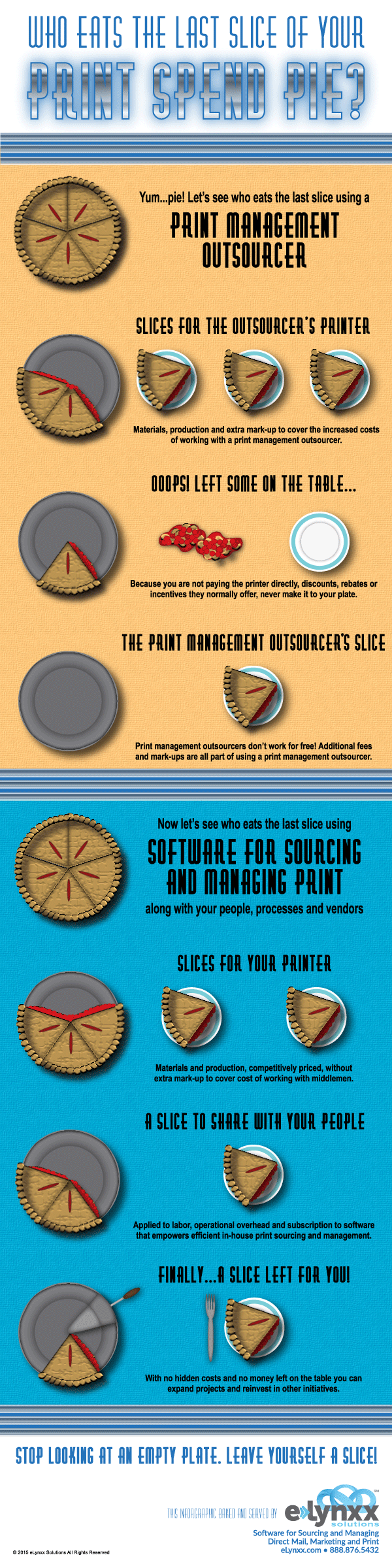
Who Eats the Last Slice of Your Print Spend Pie?

We’ve been hearing the print buying community ask “does outsourcing really save any money and where do the dollars go compared to in-house print buying?”


When you’ve been helping print buyers at many different levels for four decades you gain a lot of insight into a lot of areas. Through analysis of data, first-hand experience and knowledge gained from the trial and tribulations of people we help, this topic is one of those areas.


Because we like calculating the ratio of a circle’s circumference to its diameter as much as the next guy – and we also enjoy fruit-filled baked goods – we thought we’d start celebrating “Pi Day,” a day early with a look at Who Eats the Last Slice of Your Print Spend Pie?


Click the Image to Open – Click Again to Enlarge to Full Size


Click to View Full Size


Who Eats the Last Slice of Your Print Spend Pie?